Resource guide

Revalidation vs continuity for welder qualifications

Continuity and revalidation often appear on the same spreadsheet, but they answer different questions. This guide explains the practical difference so your team can track the right date, the right evidence, and the right next action.

Last updated . Reviewed by Soteriaa team.

Short answer

Continuity is the ongoing confirmation that a qualification has remained supported within the scope your business relies on. Revalidation is a separate control point used to confirm that the qualification can still be relied on over time. Teams usually track both because one date does not fully explain the other.
Who this is for

Most useful for teams that have two dates but one unclear workflow.

This guide helps when people know both continuity and revalidation matter, but the register does not show the difference clearly enough for day-to-day control.

QA coordinators managing live registers

People who need to explain why a record is current, due soon, or blocked without digging through certificate notes.

Teams monitoring due dates

Businesses that want to keep continuity follow-up separate from longer-cycle review or revalidation tasks.

Fabricators preparing for external review

Anyone who needs a cleaner record trail before a customer, auditor, or certification body asks how the dates are controlled.
What to track

Use separate fields so the next action is obvious.

Even if the dates appear on the same record, the safest approach is usually to keep the continuity history and the revalidation history distinct. That reduces misreads and makes the record easier to review.

A useful register shows not only the next dates, but also the evidence or method behind them. That context helps a reviewer understand why the record is still being treated as current.

  • Qualification reference, welder name, welder ID, and core qualification scope.
  • Last continuity confirmation date, supporting evidence link, and next continuity due date.
  • Revalidation due date and the basis or workflow your business uses to review it.
  • Notes on gaps, exceptions, or missing evidence so open items are visible.
  • Related WPS, WPQR, or supporting document references where they help explain the scope in use.
The exact meaning of revalidation should be reviewed against your own procedure and certification requirements.
app.soteriaa.com
Status overview
Separate the status conversation from the PDF file

A live coverage view makes it easier to spot the records that need review next.
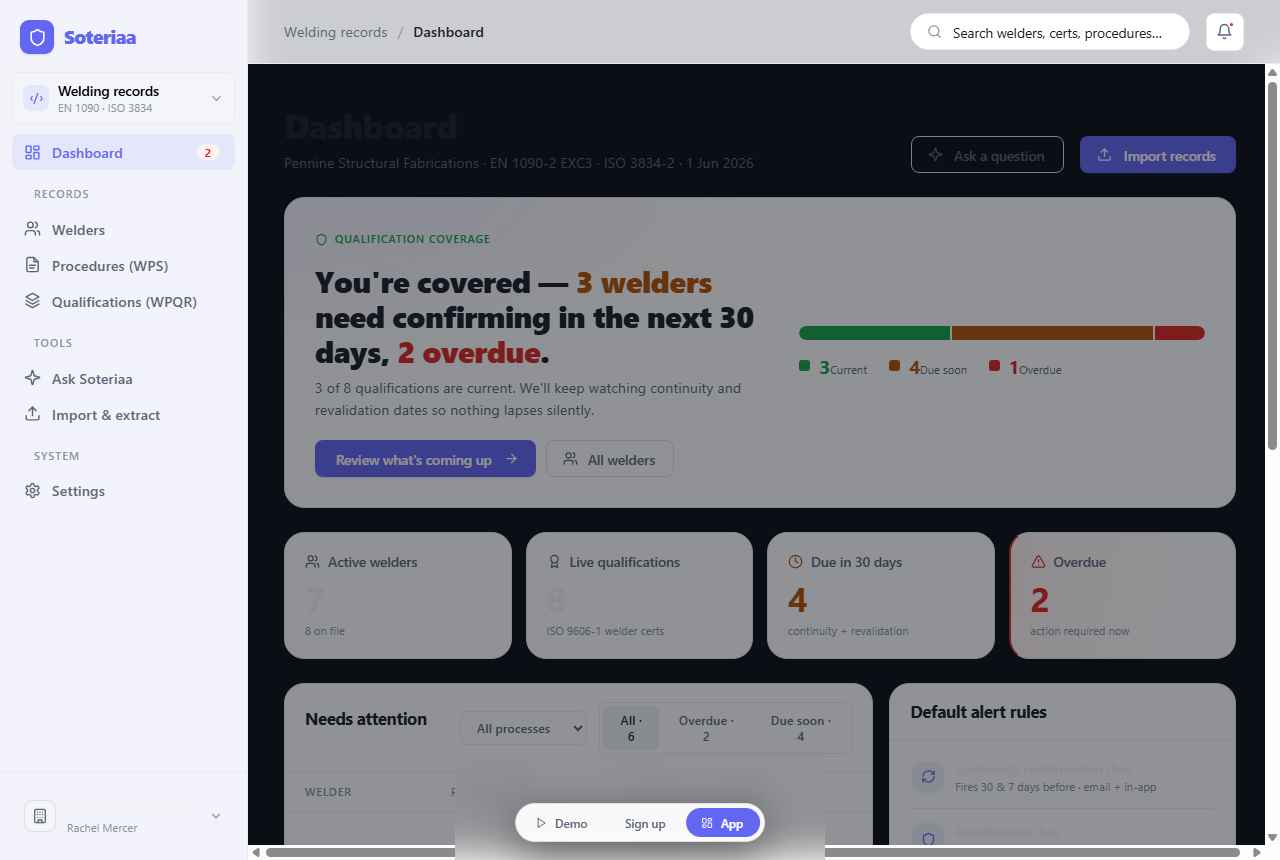
Soteriaa dashboard highlighting record status and due-date monitoring.
Spreadsheet and folder failure points

Why the two dates are often misunderstood.

The most common problems come from over-simplifying the record rather than over-complicating it.

One due-date column tries to do everything

When one date column stands in for both continuity and revalidation, the record can look current while a separate control point is actually due.

The reason behind the date is hidden

A reviewer can see a date, but not the evidence, method, or note that explains why it was chosen or updated.

The certificate PDF becomes the only source of truth

That forces every review back into the document instead of giving the team a live register that shows what has changed.

Status discussions become opinion-based

Without distinct fields and evidence, people fill the gaps from memory instead of working from the same controlled record.

Limitations and scope

This guide is for general record-management information only. It is not legal, certification, or standards interpretation advice.

Soteriaa helps organise qualification dates and supporting evidence, but it does not decide whether a qualification is revalidated or replace the review process your business relies on. Review every workflow against your own procedure and certification requirements.

FAQ

Revalidation and continuity questions

These answers are intended to make record control clearer. They are not a substitute for your own standards interpretation or certification process.
Can continuity automatically cover revalidation?
Not safely as a record-control assumption. Teams usually track the two separately because the existence of continuity evidence does not automatically answer every revalidation requirement.
Should the register hold two separate due dates?
Usually yes. A separate continuity due date and revalidation due date makes it easier to review the record and avoids confusion when one is current and the other needs attention.
What is the biggest spreadsheet mistake here?
The biggest issue is usually combining continuity and revalidation into one status or one notes field. That makes the register harder to trust and harder to explain in an audit.
Does Soteriaa decide whether a welder is revalidated?
No. Soteriaa helps organise dates, links, and evidence around the record. It does not make certification decisions or replace approved review processes.

Track continuity and revalidation as separate control points.

Give the team a clearer qualification view before the dates become hard to explain.