Resource guide

ISO 9606 welder qualification records: what to track

If a team needs to answer who is qualified, for what scope, and until when, the record needs more than a certificate PDF in a folder. This guide covers the information fabrication businesses commonly track so qualification status is clear, reviewable, and easier to maintain.

Last updated . Reviewed by Soteriaa team.

Short answer

An ISO 9606 welder qualification record commonly includes the welder's identity, certificate number, qualification standard, welding process, material group, product type, joint type, position, qualified ranges, key dates, supporting WPS or WPQR references where used internally, and the source documents that support the entry.
Who this is for

Most useful for teams that need a cleaner qualification register.

The page is written for practical record control rather than standards interpretation. It is especially useful when qualification data is still split between spreadsheets, folders, and emails.

Workshop and production managers

Teams that need to see which welder is approved for the planned work without reading every certificate by hand.

Quality and welding coordinators

People who maintain the register, gather evidence, and answer auditor or customer record requests.

Fabricators moving off spreadsheets

Businesses that already have the data, but not a reliable way to track scope, due dates, and supporting files together.
What to track

The fields teams usually want in one qualification view.

The exact structure depends on your own procedures, certification arrangements, and the way you present evidence. In practice, the record is easier to maintain when the core fields are structured instead of hidden inside a PDF file name.

Common fields are not just about identifying the certificate. They also help a reviewer see whether the qualification scope, continuity, and supporting procedure links still make sense for current work.

  • Welder name, welder ID, employee number, or stamp.
  • Certificate number and qualification standard.
  • Welding process, material group, product type, joint type, and position.
  • Qualified thickness, diameter, or other approval ranges commonly used in your workflow.
  • Test date, expiry or review basis, and examining body details.
  • Continuity due date and revalidation due date where those dates are managed internally.
  • Related WPS reference, WPQR reference, and supporting document links.
Review the exact fields you capture against your own procedure and certification requirements before standardising the register.
app.soteriaa.com
Live qualification record
See status, scope, and evidence together

Structured record fields are easier to review than a folder of certificate scans.
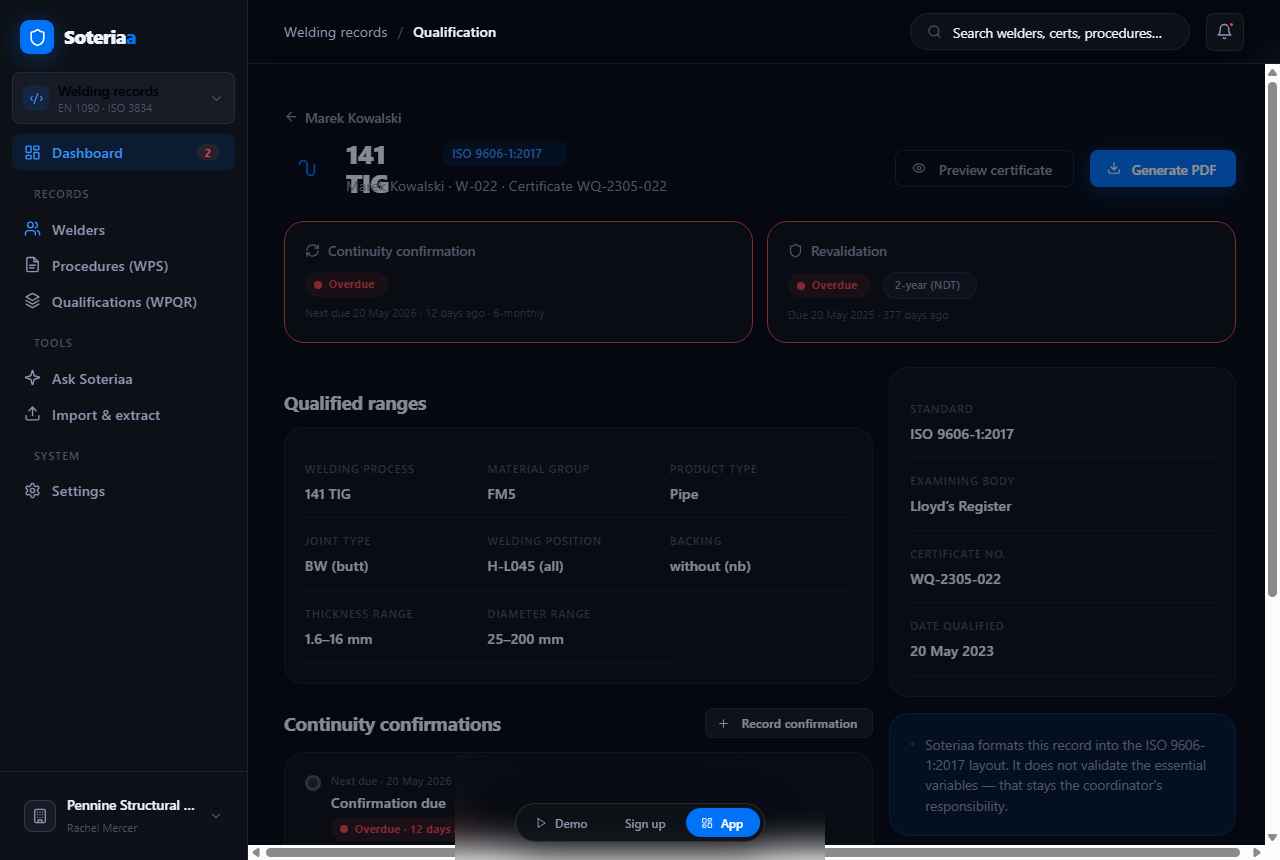
Soteriaa qualification record view with structured welder fields and supporting details.
Spreadsheet and folder failure points

Why qualification records become hard to trust.

Most problems are not about missing documents. They come from weak links between the live status view and the underlying evidence.

Dates are visible but not actionable

Continuity or revalidation dates sit in a row, but nobody gets a clear view of what is due soon, overdue, or missing evidence.

The certificate is detached from its context

A PDF may show the qualification, but not the supporting WPS reference, linked WPQR, or the continuity history people need to review next.

Multiple versions compete with each other

One spreadsheet says a welder is current, another export says they are not, and the folder does not show which record the team should trust.

Audits turn into document hunts

The data may exist, but it is slow to prove because names, references, and supporting files are not organised as one controlled record.

Limitations and scope

This guide is for general record-management information only. It is not legal, certification, or standards interpretation advice.

Soteriaa helps organise qualification records, supporting evidence, and printable outputs. It does not replace approved certificates, signed originals, or certification-body decisions. Review any record structure against your own procedure and certification requirements.

FAQ

ISO 9606 record questions

These are practical record-control questions teams usually ask when they move from certificate folders into a live register.
Should the certificate PDF be the only record?
Usually no. Teams often keep the signed certificate as supporting evidence, then track the key fields in a live register so status, scope, and due dates can be reviewed without opening every file.
Should continuity and revalidation sit on the same record?
They are commonly tracked alongside the qualification record because the dates affect whether the qualification can still be relied on, but they should remain clearly labelled as separate control points.
Can existing qualification PDFs still be used?
Yes. Many teams keep the original document as evidence and use software to organise the data around it. Review any imported data against your own procedure and certification requirements before relying on it.
Does Soteriaa certify welders?
No. Soteriaa helps organise qualification records, dates, links, and supporting documents. It does not certify welders or replace decisions made by an examining body or certification body.

Turn certificate folders into a live qualification register.

Keep the signed evidence, but give the team a clearer view of scope, due dates, and record links.